

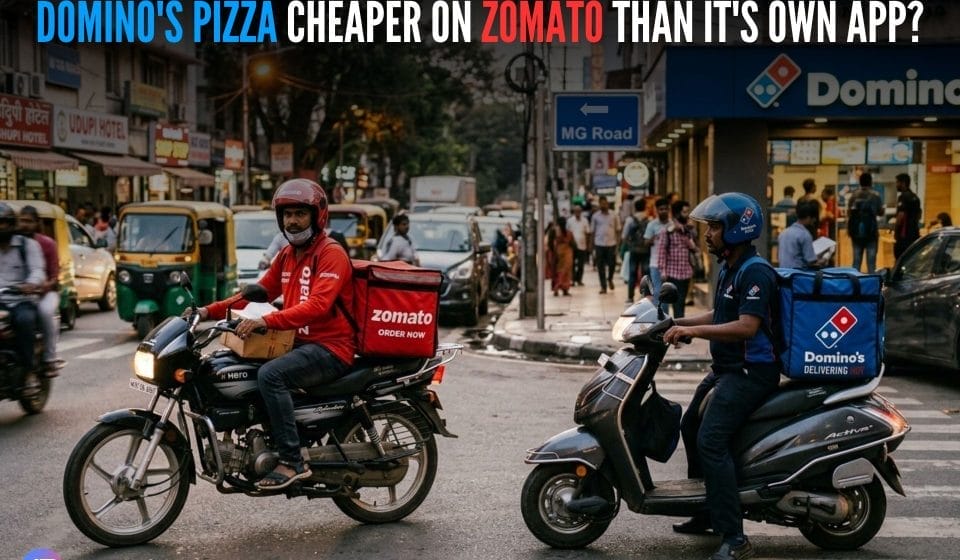
Why is ordering Domino’s on Zomato cheaper than using its own app?

A simple late-night pizza order reveals how modern platform businesses use discounts, customer behavior, retention economics, and ecosystem strategy to build long-term dominance in digital markets.
A few days ago, while working on a project late into the night, burning the midnight oil, I found myself doing what many founders, professionals, and night owls eventually end up doing after a long work session. I was hungry, tired, and debating whether ordering a pizza at that hour was a terrible life decision or a perfectly acceptable coping mechanism for startup culture and sleep deprivation.
Table Of Content
- Why do our brains expect Domino’s to be cheaper?
- Domino’s and Zomato are solving different business problems
- Why is Domino’s not competing on discounts?
- Why is Zomato comfortable giving ₹200 discounts?
- So who is actually losing money here?
- The platform strategy behind this relationship
- What does this reveal about startup ecosystems and survival?
- The larger takeaway
Out of curiosity, I opened both the Domino’s Pizza app and Zomato and added the exact same order to both carts. Same pizza, same outlet, same delivery location, and the same timing. Yet the final order on Zomato turned out to be almost ₹150 cheaper.
Domino’s was offering a discount of around ₹30 on its app, while Zomato offered a ₹200 discount. Zomato even charged a delivery fee, and both platforms applied taxes, yet the overall order value on Zomato was still significantly lower.
That immediately created confusion because, logically, Domino’s should have been cheaper. Domino’s owns the kitchen, manufactures the pizza, operates the outlet, runs its own application, and even maintains a large part of its own delivery fleet. Zomato sits in the middle as a platform and charges restaurants a commission for every order routed through the app. Under traditional business logic, removing the intermediary should reduce costs. So how does the intermediary end up offering a lower final price than the original seller?
At first glance, the economics appears irrational. But once we look deeper, this small pricing puzzle reveals one of the most important shifts happening across modern business ecosystems, platform economies, and startup strategy. It also connects deeply with the ideas explored in my upcoming book, Survival of the Smartest: Startups through the lens of Evolution, where I discuss evolutionary thinking in startups and how businesses adapt, compete, and survive within changing ecosystems.
Why do our brains expect Domino’s to be cheaper?
The confusion itself is perfectly logical because most of us still subconsciously think in terms of traditional industrial pricing economics. Historically, buying directly from the source usually reduced costs because fewer intermediaries were involved. If you buy vegetables directly from a farmer rather than a retail chain, the price is usually lower because multiple layers of margin disappear. The same logic should, in theory, apply to food delivery.
If a customer orders directly from Domino’s, there should be no platform commission, no marketplace dependency, and better operational efficiency. The Domino’s app should technically become the cheapest channel for customers.
But digital platforms no longer function like traditional supply chains. An intermediary in a platform economy is not merely forwarding transactions from one side to the other. Platforms such as Zomato function as customer acquisition engines, behavioral marketplaces, recommendation systems, search layers, and convenience infrastructure. Domino’s is not paying Zomato simply to process an order. Domino’s is paying Zomato to exist inside a large digital ecosystem where millions of users are already searching for food. This distinction changes the economics completely.
Domino’s and Zomato are solving different business problems
One of the biggest mistakes people make while analyzing modern digital businesses is assuming that both companies are trying to solve the same problem. In reality, they are operating at completely different stages of the customer behavior cycle.
The Domino’s app primarily serves customers who already know they want Domino’s. The user has already made the decision before opening the app. Brand preference already exists. Intent already exists. The app’s role is to efficiently complete the transaction and maintain customer retention.
Zomato operates much earlier in the consumer journey. A customer opening Zomato may not even know what they want to eat. They may browse pizza, burgers, biryani, desserts, Chinese food, local restaurants, or cloud kitchens. Inside that ecosystem, Domino’s becomes one option among many.
This difference is strategically important because the Domino’s app focuses on loyalty and retention, while Zomato focuses on discovery, engagement, and customer acquisition. The two businesses are participating in the same transaction while solving completely different business challenges.
Why is Domino’s not competing on discounts?
When Domino’s offers a relatively small discount on its own application, that is not a weakness or a poor pricing strategy. It is actually a sign that the company understands where the customer already stands in the funnel. A customer using the Domino’s app has already downloaded the app, created an account, remembered the brand, opened the app intentionally, and demonstrated repeat-purchase behavior. From Domino’s perspective, the expensive part of the process is already complete. Customer awareness and acquisition have already happened.
The company’s priority now shifts to maintaining loyalty, improving retention, increasing repeat-ordering frequency, and building long-term direct relationships with users. The ₹30 discount functions more like a small retention nudge than a deep acquisition strategy. Zomato operates under a very different set of incentives.
Why is Zomato comfortable giving ₹200 discounts?
This is where platform economics becomes fascinating. The ₹200 discount visible on Zomato is often not funded by Domino’s itself. In many cases, the platform absorbs a large portion of that cost through its own customer acquisition and marketing budget.
At first glance, that sounds irrational. Why would any company willingly lose money on a transaction? Especially when they are already in the ecosystem. The answer becomes obvious once we understand how platforms operate. Zomato is not treating your order as a single pizza transaction. It is evaluating your long-term behavioral value as a customer.
Every business spends money to acquire users, and the cost to acquire a customer is known as the Customer Acquisition Cost (CAC). Some companies use television advertising. Some rely on influencer campaigns. Others spend heavily on Google and Meta ads. Zomato itself spent years building its user base through aggressive marketing, branding initiatives, incentives, promotions, and discounts. But that phase is largely history now. What matters far more at this stage is retention.
Platform businesses survive on user frequency and habit formation. User churn can quietly weaken the entire platform model. This is no longer just a customer acquisition expense. It is the cost of retention. The cost of keeping users inside the ecosystem. The cost of ensuring that, when someone feels hungry, Zomato becomes the default instinct rather than just one among many options.
That is where the economics changes completely. For a platform business, losing a user is rarely just the loss of one transaction. It affects repeat orders, future commissions, engagement frequency, subscription potential, recommendation data, and overall ecosystem activity. Platform businesses benefit heavily from compounding behavioral effects. The more frequently users engage, the stronger the ecosystem becomes for every participant inside it.
From that perspective, a ₹150 discount on a pizza order no longer looks like a loss but rather an investment in preserving long-term ecosystem behavior. The logic is simple. If Zomato spends ₹200 today and successfully builds a habit where you instinctively open Zomato whenever you feel hungry, the economics starts to make sense over the long term.
Suppose an average customer orders food twice a week with an average order value of ₹500. That translates to roughly ₹50,000 in annual transactions flowing through the platform. Over multiple years, that customer generates recurring commissions, ecosystem engagement, subscription opportunities, advertising value, and valuable behavioral data. Suddenly, the ₹200 discount no longer looks like a loss. It starts looking like a calculated investment in future customer behavior.
The discount is essentially an advertising expense disguised as a customer benefit.
So who is actually losing money here?
Interestingly, nobody is structurally losing in this ecosystem. Each participant gains something different from the transaction.
Domino’s gains visibility, incremental customers, additional order volume, platform traffic, and access to discovery. Many customers ordering Domino’s through Zomato would probably never have opened the Domino’s app directly. These are incremental orders generated through platform discovery rather than cannibalized direct sales. Domino’s also benefits because it often maintains control over its own logistics infrastructure. Unlike smaller restaurants that depend entirely on Zomato’s delivery fleet, Domino’s already has operational systems at scale. This changes the unit economics significantly.
Zomato gains customer engagement, repeat usage, behavioral retention, ecosystem dependence, network effects, and long-term monetization opportunities. Food delivery is among the highest-frequency digital behaviors, making customer retention extremely valuable for platforms.
The customer gains lower pricing, convenience, centralized ordering, faster comparison, and easier decision-making. The transaction appears irrational only in isolation. The moment we evaluate it as part of a long-term ecosystem strategy, the economics start making complete sense.
The platform strategy behind this relationship
What makes this dynamic especially interesting is that Domino’s and Zomato are simultaneously partners and competitors. They are partners because Zomato drives enormous customer traffic and order volume toward Domino’s. More visibility means more orders, more operational utilization, more revenue, and more brand exposure. Domino’s wants to exist wherever hungry customers are searching for food.
At the same time, they are competitors because Zomato wants users to think of Zomato first, not Domino’s. When a customer opens Zomato and searches for pizza, Domino’s appears alongside dozens of competing restaurants and cloud kitchens. The platform ultimately controls visibility, recommendation systems, ranking positions, and discovery behavior.
This is why Domino’s continues investing heavily in its own app and direct ecosystem. The company does not want to rely entirely on Zomato’s algorithm for customer access. The moment a business fully depends on a platform for visibility, the platform gains enormous leverage. Let’s take an example of most restaurants before Zomato. Every one of them used to have some delivery staff or at least a small-scale delivery capability. Now, no restaurants have delivery capabilities, so they are dependent on Zomato not only for discovery but also for delivery, allowing Zomato to charge a hefty commission.
This pattern exists across almost every major technology ecosystem today. Sellers depend on Amazon, creators depend on YouTube, apps depend on Apple’s App Store, hotels depend on Booking.com, and restaurants increasingly depend on food delivery platforms. Over time, platforms evolve from intermediaries into infrastructure layers.
Interestingly, traditional industrial-age thinking doesn’t take platform dependency into account. Obviously so because digital platforms came into existence recently.
What does this reveal about startup ecosystems and survival?
This seemingly simple pizza-ordering observation actually connects deeply with several ideas explored in my upcoming book Survival of the Smartest.
Startup ecosystems evolve continuously. As environments change, the traits required for long-term survival also change. At one point, manufacturing strength created dominance. Then, the operational scale became the key advantage. Then, the distribution networks created leverage. Today, customer access, ecosystem positioning, behavioral integration, convenience infrastructure, network effects, and platform control increasingly shape competitive advantage.
Businesses evolve alongside changing environments, much like organisms evolve inside changing ecosystems. Domino’s evolved from being a pizza company into a digitally enabled consumer ecosystem with loyalty systems, app infrastructure, customer retention mechanisms, and delivery networks. Zomato evolved from a restaurant discovery platform into a behavioral marketplace, a recommendation engine, a convenience ecosystem, and a customer acquisition infrastructure.
Both companies evolved differently within the same ecosystem. Both are trying to secure long-term survival from different strategic positions.
That is one of the most fascinating realities of modern startup ecosystems. Competitive advantage increasingly emerges from ecosystem relevance, behavioral integration, and strategic positioning within digital environments.
The larger takeaway
The next time you see a massive discount on a food delivery app, ask a simple question, who is funding this? In most cases, it is not the restaurant. Restaurants generally operate on thin margins and cannot afford to subsidize customer behavior aggressively. The platform funds these discounts because it is investing in long-term ecosystem growth, customer acquisition, and behavioral retention. The restaurant gets revenue. The platform gets your attention and future loyalty. Investors fund the long-term growth bet. And the customer gets cheaper pizza. That is the platform economy working exactly as designed.
And hidden inside that late-night pizza order is one of the clearest examples of how modern startups evolve, compete, adapt, and survive inside rapidly changing digital ecosystems.
If you found this perspective interesting and would like to explore more about evolutionary entrepreneurship, startup ecosystems, adaptation, survival, and how businesses evolve within changing environments, do check out my upcoming book, Survival of the Smartest.